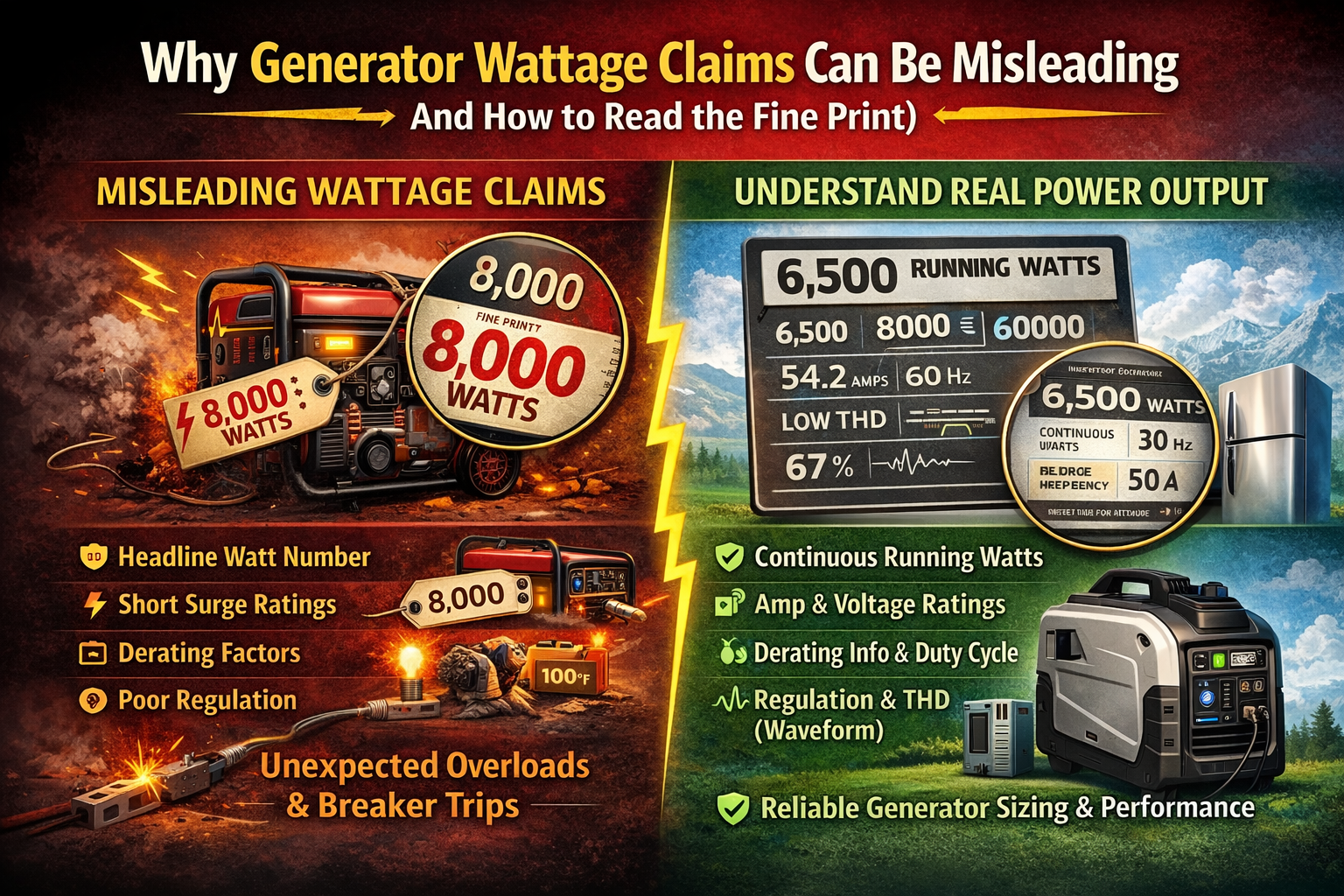
Generator shoppers comparing spec sheets who want to understand what wattage numbers mean in real use and how to avoid undersizing.
If you size a generator based on a headline wattage number, you can end up with nuisance breaker trips, hard starting motors, dimming lights, or electronics that reset due to low voltage. In some cases the generator is not defective at all, it is simply being asked to deliver more continuous power or more starting surge than it can provide under real conditions. Understanding the fine print helps you match the generator to your loads and avoid unstable power.
Definition: The electrical power a generator can supply continuously at its rated voltage and frequency without exceeding thermal and mechanical limits.
This is the wattage you can count on for normal operation. It is usually lower than the big number on the box.
Definition: The short-duration power a generator can supply to handle inrush current when certain loads start, typically for seconds or less.
Motors can need extra power to start. A generator may advertise a high surge number even if it cannot sustain that level.
Definition: VA is apparent power (volts times amps). Watts is real power delivered to the load. Power factor is the ratio of watts to VA.
Some loads draw current that does not turn into useful work. A generator can hit its current limit before it reaches the advertised watts if the power factor is low.
Definition: Voltage regulation is how closely output voltage is held as load changes. Frequency regulation is how closely output frequency is held as load changes.
A generator can technically be producing power, but if voltage sags or frequency droops under load, equipment may not run correctly.
Definition: A measure of waveform distortion relative to a pure sine wave, expressed as a percentage.
Lower THD is generally more compatible with sensitive electronics. Some generators can meet wattage claims but still produce a rougher waveform.
Definition: A reduction in allowable output due to operating conditions such as altitude, temperature, fuel type, or continuous duty limits.
The generator may be rated at ideal conditions. In real use, it can produce less power safely.
Mistake: Assuming the largest watt number on the label is usable all the time
Mistake: Adding appliance nameplate watts without considering starting surge and power factor
Mistake: Ignoring voltage and amperage ratings
Mistake: Assuming all generators hold voltage and frequency equally under load
Mistake: Overlooking derating factors like altitude, temperature, and fuel type
To understand what you are actually getting, translate the marketing wattage into practical limits: continuous watts at your required voltage, plus enough surge capability for the largest starting load. Then confirm the generator can deliver the needed amps on the specific outlets you will use, and that voltage and frequency stay within acceptable ranges when loads cycle. If you plan to power electronics, consider THD and regulation quality, not just wattage. Finally, leave headroom for derating and for loads that cycle on and off, because a generator that is constantly near its limit will run hotter and may have more voltage droop.
Wattage misunderstandings often lead people to improvise connections or placement to make a setup work. Use safe connection methods and safe placement regardless of size, and plan capacity correctly so you do not feel pressured to bypass protections.
⚠️ Carbon monoxide: NEVER run a generator indoors due to carbon monoxide.
⚠️ Indoor use: Use outdoors only, at least 20 feet from windows/doors/vents.
⚠️ Fuel storage: Store fuel in approved containers and away from living areas.
⚠️ Backfeeding: NEVER connect a generator directly to household wiring without a transfer switch to prevent backfeed.
Generator breakers respond to current (amps) and heat buildup, not just wattage. A load with a high starting surge—such as a refrigerator compressor or sump pump motor—can momentarily draw several times its running amps, which may exceed the breaker's trip threshold. Loads with a low power factor also draw more amps per watt of useful work, pushing current higher than you might expect from the wattage alone. Additionally, when generator voltage sags under heavy load, connected equipment compensates by drawing even more current, compounding the problem. It is also important to remember that individual receptacles and circuits on a generator have their own amp limits (for example, a 20-amp duplex outlet), which can trip independently before the generator reaches its overall rated running watts. To troubleshoot, check the amp draw of each circuit rather than relying solely on total wattage calculations.
Always use the continuous (running) watts at the specific voltage you need—120V, 240V, or both—as your primary sizing number, not the larger peak or surge wattage prominently displayed on packaging. The surge or peak watt rating only applies for brief moments during motor startup events and cannot be sustained. After establishing your continuous wattage baseline, verify that the generator has enough surge capacity to handle the single largest starting load you expect to run, such as a well pump or air conditioner compressor. You should also confirm the available amperage on the specific outlet types you plan to use, because a generator may have sufficient total wattage but not enough amps on a particular receptacle to power your equipment. As a practical rule of thumb, add up the running watts of everything you plan to power simultaneously, then add the highest single starting surge on top of that total. Finally, build in at least 10–20% headroom above your calculated need to account for derating factors like altitude, temperature, and the natural efficiency loss that comes with running a generator near its maximum capacity.
Watts and volt-amps (VA) are related but distinct electrical measurements that appear on generator specifications, and confusing them is a common cause of undersizing. VA is apparent power, calculated by multiplying volts times amps, and it represents the total electrical demand placed on the generator's alternator and wiring. Watts, on the other hand, is real power—the portion of apparent power that actually performs useful work in your appliances. The ratio between watts and VA is called the power factor, and it ranges from 0 to 1. Purely resistive loads like space heaters and incandescent light bulbs have a power factor near 1.0, meaning watts and VA are nearly equal. However, inductive loads like motors, pumps, and fluorescent lighting can have power factors of 0.5 to 0.8, meaning the generator must supply significantly more current (and therefore more VA) than the watt rating alone suggests. In practical terms, this means a generator can reach its maximum current output—and trip a breaker or experience voltage sag—well before it reaches its advertised wattage if you are running multiple low-power-factor loads. When comparing generator spec sheets, look for both the watt rating and the VA rating to get a complete picture of the unit's real capacity.
Altitude and ambient temperature directly affect the air density available to the generator's engine, which in turn reduces the mechanical power it can produce and the electrical output the alternator can deliver. At higher elevations, the air is thinner, meaning less oxygen enters the combustion chamber per engine cycle, resulting in less fuel being burned efficiently. A common industry guideline is to derate generator output by approximately 3–3.5% for every 1,000 feet above 500 feet of elevation, though exact figures vary by manufacturer and engine design. Similarly, high ambient temperatures reduce air density and impair the engine's and alternator's ability to shed heat, which can cause the generator to overheat or trigger thermal protection shutdowns if run near its rated capacity. For example, a generator rated at sea level and 77°F (25°C) may produce noticeably less power on a hot summer day at a mountain cabin sitting at 5,000 feet elevation. Always consult the manufacturer's derating chart in the owner's manual and factor these reductions into your sizing calculations. If you regularly operate in high-altitude or high-heat environments, consider selecting a generator with a higher continuous wattage rating than your baseline calculation suggests to maintain reliable performance.
Both inverter generators and conventional (open-frame) generators list running watts and surge watts on their spec sheets, but the way each type delivers that power in real-world conditions can differ significantly. Inverter generators use electronic circuitry to convert raw AC power to DC and then back to a clean AC sine wave, which typically results in tighter voltage regulation, more stable frequency control, and lower total harmonic distortion (THD)—often below 3%. This makes them well-suited for sensitive electronics like laptops, smartphones, and medical devices. Conventional generators produce AC power directly from the alternator and rely on mechanical engine speed (governed RPM) to maintain voltage and frequency, which can result in wider fluctuations under changing loads. This means a conventional generator and an inverter generator with identical wattage ratings on paper may perform quite differently when powering the same equipment—the conventional unit might experience more voltage sag during motor starts or produce a rougher waveform that causes issues with electronics. When comparing spec sheets, look beyond the wattage numbers and also evaluate THD percentage, voltage regulation tolerance, and frequency regulation to understand how each generator will actually perform with your specific loads. Keep in mind that inverter generators are generally quieter and more fuel-efficient at partial loads, while conventional generators often offer higher maximum output for the same physical size and weight.
Motor-driven appliances like refrigerators, well pumps, sump pumps, and air compressors require a brief but significant surge of power to start—often 2 to 5 times their running wattage—and this starting surge is the most common reason generators struggle with these loads. To determine compatibility, first find the appliance's starting (locked rotor) amps or starting watts, which may be listed on the appliance nameplate, in the owner's manual, or available from the manufacturer. Multiply the locked rotor amps by the operating voltage (typically 120V or 240V) to estimate the starting VA demand. Then compare that figure to the generator's rated surge watts, keeping in mind that the generator must also continue powering everything else that is already running at the same time. It is equally important to check the amperage rating of the specific generator outlet you plan to use, because a 15-amp or 20-amp receptacle will limit how much current can flow regardless of the generator's total capacity. If the generator's voltage sags significantly during the start attempt—something that can happen even when the surge watt number appears adequate—the motor may stall, fail to start, or start slowly and overheat. For particularly demanding loads, consider using a hard-start kit on the appliance (which reduces inrush current) or staggering your startup sequence so the motor-driven appliance starts first before other loads are connected. Always exercise proper safety precautions: never run a generator indoors or in enclosed spaces due to the deadly risk of carbon monoxide poisoning, and never backfeed power into household wiring without a properly installed transfer switch.