
I had just moved to a rural property and owned a generator I grabbed on impulse. I saw the wattage rating on the box, figured it would handle whatever I needed, and didn't really think about it again until the power went out and stayed out. Turns out that generator had a really high total harmonic distortion rating, which basically meant I couldn't trust it to run anything with sensitive electronics. I spent five days juggling extension cords, rotating what I could plug in, and generally just trying to keep things running.
While I was sitting there waiting for the power to come back I started doing research. I wanted to compare generators the way you'd compare any other piece of equipment. Spec for spec, apples to apples. But the information was all over the place. Every manufacturer presented their specs differently. Wattage ratings weren't consistent. Noise levels were tested under different conditions. Some brands didn't even publish their THD numbers. Just trying to get a real comparison between two similar generators meant opening a bunch of tabs and pulling data into my own spreadsheet.
So that's exactly what I did. And the spreadsheet just kept growing. More models, more brands, more specs. At some point it got big enough that a spreadsheet didn't really make sense anymore and I figured other people were probably dealing with the same problem I was. That's how RightGenerator became a website.
What changed on day five
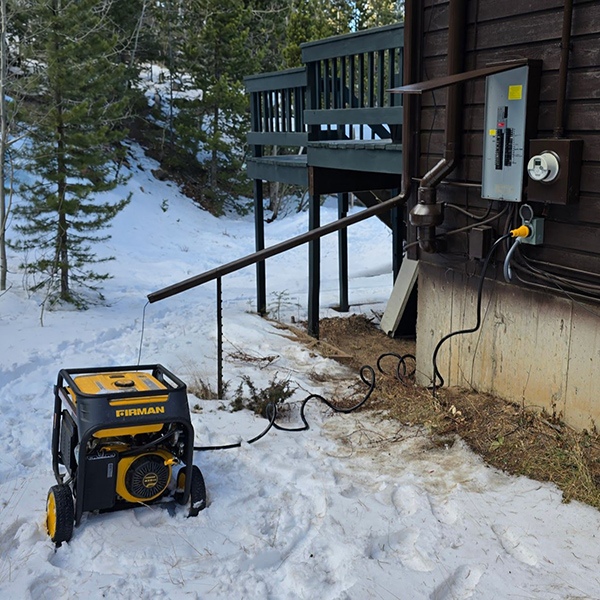
By day five of that outage, the workaround life was not sustainable. I had a local electrician install a 50A generator interlock kit and a dedicated power inlet. That was the turning point. Being able to feed the panel through a proper interlock meant the furnace could stay on and the well pump could keep running without a mess of extension cords.
It also made the next problem obvious: not every generator is built for a modern whole-house backup setup. Total harmonic distortion was not just a spec buried in a manual. It was the difference between keeping the house warm and taking a risk with furnace controls, electronics, and other sensitive equipment.
How this site actually works
Every generator on this site is scored using a system that is completely transparent. We normalize specs across wattage bands and product types so you're always comparing similar generators against each other. The scoring looks at running and starting watts, noise, weight, runtime, inverter quality, warranty, and price. Nothing is hidden and nothing is sponsored. If we recommend something you can see exactly why it scored the way it did.
Because I have lived through a 50A backup scenario, I do not just look at peak watts. Inverter quality and THD matter in the scoring because clean power matters for modern homes with HVAC controllers, electronics, chargers, and other sensitive loads. If a generator has plenty of watts but poor power quality, I do not treat that as a minor footnote.
We pull real pricing from multiple retailers so you're looking at what things actually cost right now, not some MSRP from six months ago. And our comparison tools have rules built in so we're not putting a little 2000 watt inverter generator next to a 10,000 watt open frame unit and pretending that's a useful comparison.
Who I am

AJ Quick
Mechanical engineer, founder of RightGenerator, and the person behind the reviews and analysis on this site.
I'm a mechanical engineer living in Colorado. I built RightGenerator after a five day outage forced me to learn the hard way that generator specs are not as simple as the wattage number on the box. I write the generator reviews, build the comparison logic, and maintain the scoring system so the site reflects real tradeoffs: usable power, noise, weight, runtime, inverter quality, THD, warranty, and what the generator actually costs.
I use automation to collect and normalize specs at scale, but the recommendations are intentionally editorial. When a generator is too loud, too heavy, too expensive for its output, or risky for sensitive electronics, I want the page to say that plainly.